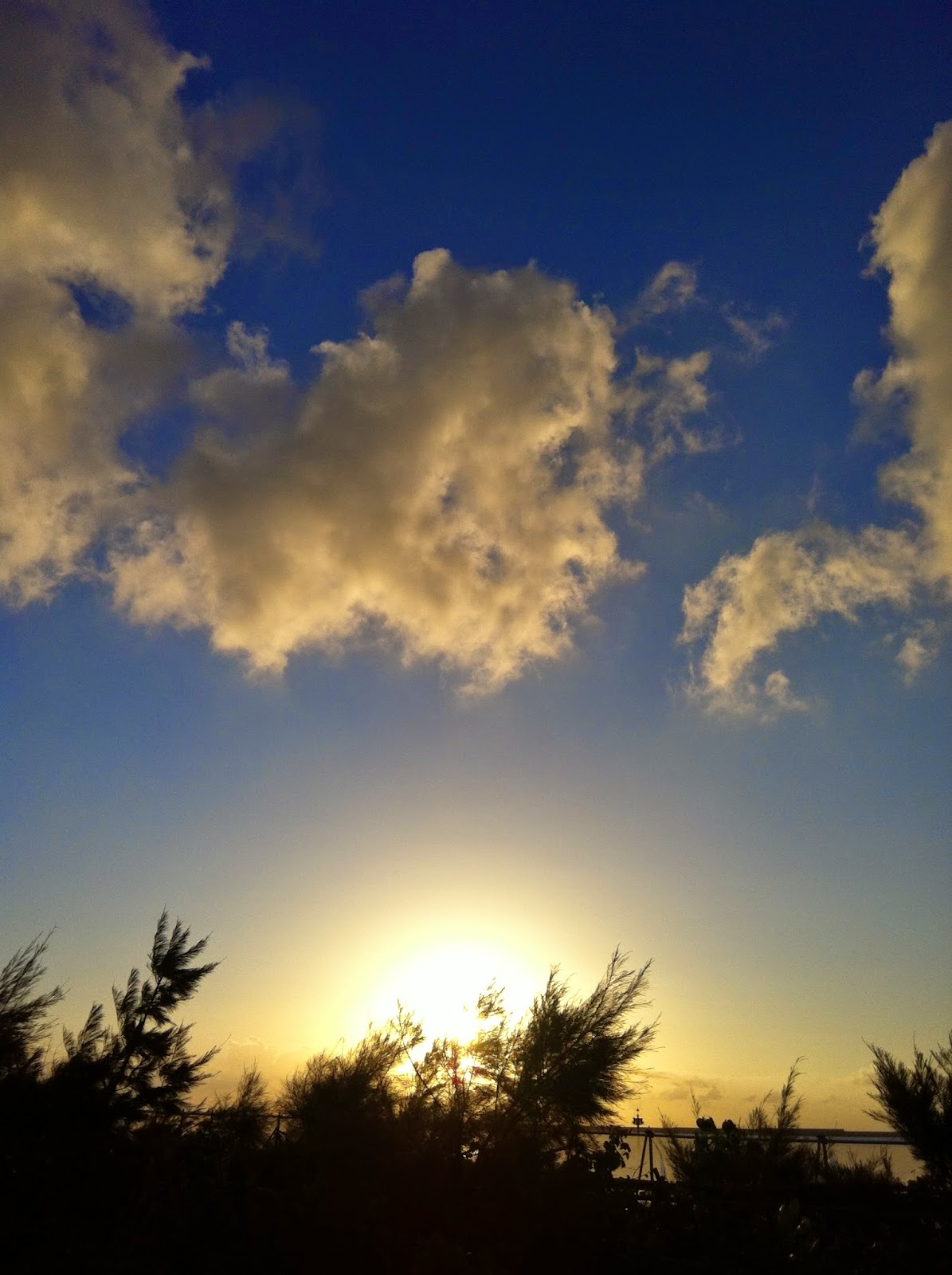
| View of Kokusai from the Starbucks |
英語の弁当/English Bento Box
Prepared for you with love from Okinawa, Japan.
Friday, June 14, 2013
The Quotidian and the Process
I've been without internet at my apartment for more than a week. How did I ever live without the internet? I know I did, but it is exasperating. I'm sitting here now at Starbucks, verifying that the issue is a network one at my apartment and not related to my network adaptor. Thank goodness, because I'm broke. Payday cannot come sooner.
Wednesday, June 5, 2013
イントロダクション!!ボディムーブメントの世界へ
I started teaching an Intro to Physical Theater class last Saturday at ひやみかち学校. The class went successfully with three Japanese participants (a small showing, but I believe the class enrollment will start to increase). I was interviewed by NHK. The journalist stayed the entire 2 hours for my class, videoing and watching the various activities and games we played. I was really pleased at how open minded and excited the participants in the class were. They were really fearless. One of them had never even tried theater but had always wanted to and, like myself, is a Chelfitsch/Toshiki Okada fan, so we have a commonality in our aesthetic choice.
Speaking of language, I taught the majority of the class in English but since most of the games and activities are movement based, we often did not need to rely on spoken language, apart from my instruction (which was sometimes translated, when necessary). It was really an experiment for me to try to teach adults theater with this massive language barrier. But as I told them in the class, the aim is to create a common language - a language of theater which combines creative use of space and time. We did a number of abstract exercises that combined some of the Viewpoints training that I know, with some other devised ensemble approaches to theater, as well as improv.
Monday, June 3, 2013
The Direction(s) of Your Life
I always think of my blog posts when I'm far away from my computer (and I really can't write via my iphone, it's just not feasible), so I then end up forgetting about the topics I want to write about. Today, I think I'm just going to write about something on my mind that's been really bothering me. This thing that's got me down is affecting everyone globally, but it started in the USA and Western Europe. I was at the center of it in NYC in the finance industry when it began to crumble and implode on itself.
The 2008 economical meltdown didn't become the overnight depression that everyone thought it might. Instead, it robbed a generation (actually, future generations) of their ability to live without struggling. And now with some perspective, I believe it's become a restructuring of the global economy that will lead to all countries eventually be on the same playing field, rather than some having economic prosperity while others are barely above survival level. It's just a theory of mine. I can't back it up with economic data. Sorry. Some people have retained their employment, though their workload has probably increased or doubled and if they're not in the executive level of their corporation, they probably haven't received bonuses. Yet while many people are not unemployed, others have sought month after month to find meaningful work, while they go haplessly from one temporary gig to another. Yet, still another thing is happening: the gradual restructuring of careers that pay at the level one needs to be able to survive to jobs that pay at or close to minimum wage. What I mean is that while food and rent and utilities have increased or maintained current levels, wages have decreased, or jobs that were well paying have been outsourced to employees that will be paid only half the amount. Sometimes this outsourcing and downgrading happens directly to those who have held their positions for their entire careers. Here is an example of how this is happening across the USA.
Sunday, June 2, 2013
Liebster Award (ありがとうございます!)
About a month ago, I received a nomination from Sophelia for the Liebster Award. It's a small award that's actually a chain letter meant to connect bloggers to each other. I haven't had time to answer it until now, so here goes. I have to answer questions that Sophelia posted and then make my own to pass on to other blogs which I love to read. Shamefully, I only read a handful of blogs, which makes me a bad, bad blogger I think. But I'll pass this award on dutifully.
10 Questions from Sophelia
What is the most important thing you read online this week? Links please!
Which country that you have never visited do you most want to go to?
What is the worst movie you have ever seen?
What song do you listen to when you are most in need of a pick-me-up?
What children’s book describes the meaning of life best in your eyes? Ahh, you noticed that wasn't a new question, huh? Glad that you are paying attention. I still want to ask it anyway, because I think it is a fantastic question!
Can you name a movie adaptation that was better than the book?
What if your favourite vegetarian recipe? Again, links or post in full please ;)
What was your very first pet's name?
What is your "guilty pleasure" TV show?
Tell me about a book that changed how you see the world.
Answers:
1. Oh man...Probably that the Mayor of Osaka had finally apologized for his horrendous comments.
2. Australia and Thailand
3. . I tend to turn off any movies that I think are awful. I'd stay "The Stupids" was really, really bad. I sat through 5 minutes of that one.
4. Anything by Blonde Redhead
5. Tuck Everlasting. I really enjoyed the concept of living life to the fullest that one can in their own lifetime, because immortality isn't possible (and even if it were, in the case of the Tuck family, their are drawbacks) . Also, I really love "love stories" and that was a YA love story. Much better than Twilight.
6. Hm...."The Mist" was a wonderful adaptation of a short story by Stephen King. I think it did the story a favor with the shift in the ending. Wow, that ending...
7. I like vegetarian Spanish omelet (though I suppose it's ovo-lacto vegetarian).
8. Pi
9. Mad Men
10. I recently read "Wild" by Cheryl Strayed and I really loved it, though I know it's not epic. I think maybe the most memorable books that I've read in my life are "Pedro Paramo," by Juan Rulfo, "L'amant" by Marguerite Duras, "Dance Dance Dance" by Murakami Haruki (I know it's not his most well known book, but it's my favorite of his), and I really enjoyed " How to Live: A Life of Montaigne -One Question and Twenty Attempts at an Answer" by Sarah Bakewell. I would also say that Anthony Bourdain's "Kitchen Confidential" was life changing at the time that I read it.
10 Questions for You:
1. What's your favorite movie and why?
2. What book did you read recently that you loved?
3. What obscure historical fact do you know?
4. What languages do you speak? What languages do you wish you could speak?
5. What famous art work do you most identify with?
6. What Japanese music do you listen to?
7. Where in Japan do you recommend visiting?
8. Why did you come to Japan (or why do you want to move or visit Japan)?
9. What city is your favorite city in the world?
10. One fact about yourself.
1. What's your favorite movie and why?
2. What book did you read recently that you loved?
3. What obscure historical fact do you know?
4. What languages do you speak? What languages do you wish you could speak?
5. What famous art work do you most identify with?
6. What Japanese music do you listen to?
7. Where in Japan do you recommend visiting?
8. Why did you come to Japan (or why do you want to move or visit Japan)?
9. What city is your favorite city in the world?
10. One fact about yourself.
Friday, May 24, 2013
The Deep North: 東北:陸前高田と気仙沼 (Part II)
When we arrived in Kawasaki, Miyagi, it was nearly 8AM, and we had another hour to travel before we reached the coast. We were told to prepare for the day, which meant changing in the public restrooms at the rest stop and waking up, regardless of how groggy we felt. Y. and I had been awake most of the trip starting around 5AM, so we felt worn. After Kawasaki, we headed east towards the coast. I have to admit, I don't remember much of this stretch, so I suspect I must have dozed for another hour. I do remember thinking about whether I'd recognize these towns from the footage on television of the tsunami. We live in a hyper-mediated age, and even though I don't own a television, I'm plugged in enough via the Internet to get a sense of simulacra, which is a horrible way to feel when you know what you're witnessing left everyone in the region with a gaping hole in the hearts. Thankfully, I didn't get that “more authentic than the real thing” feeling when we entered Rikuzentakata.
| Driving along the coast towards Rikuzentakata |
| Tsunami Inundation signs |
Tuesday, May 14, 2013
Lights to the North: A Chronological Account of Volunteering in Tohoku (Part I)
"People's outdated beliefs are piled up around the house.Some Notes
--Rather pale like a gravestone.
Cool in the summer, warm in the winter.
For a moment, I thought flowers had bloomed.
It was a flock of aging snow."
- Gate of Snow, Chika Sagawa trans. by Sawako Nakayasu
This is a chronological account of my trip to Tohoku. Rather than it being non-linear or starting in the middle of the journey, I found it easier to write about it as I remembered the entire experience. I've also written it this way so that I can remember it better. The title of this entry "Lights to the North," is taken from the title of a short play I wrote about post-tsunami Tohoku and its people and the issues they're facing.
I'm currently at work on a larger creative project about my trip to Tohoku, so this is going to be a straightforward account of what I saw and how I remember it. It'll begin in Tokyo...
I've decided to break it in half, as its too lengthy for one blog post.
| NEX to Tokyo Station |
Monday, May 6, 2013
Love
I don't know where to begin when writing about the Golden Week volunteer trip to Rikuzentakata.
The experience was tremendously life changing in some ways. But then, I suppose every moment has the potential to be life changing. Perhaps that's the theme around Rikuzentakata. It is...or was...a small sea side town located in southern Iwate, just over the Miyagi-ken border. And just like many small sea side towns in Tohoku, the lives of everyone living in this city were altered forever on March 11th, 2011.
Since I didn't live in this region and didn't experience the tragedy first hand, I will always be an observer. I do remember that day very vividly though. I was just on my way to the Kohamajima port to take my return ferry back to Ishigakijima when the earthquake occurred, and while I was waiting for my boat, the tsunami had started to upend and catastrophically destroy everything in its path. I think about that point in time, whenever I think about Tohoku. For it's those moments that one can freeze in the mind's eye, realizing that 2 years later, those moments in time were the last for many people. Those moments that were taken for granted by everyone else not experiencing the tsunami firsthand. I think about how some of the people in Rikuzentakata, Minamisanriku, Kesennuma, or Ishinomaki (or any of the other towns and cities affected) didn't realize that those were their last moments. After that, time was only available to those who survived and would have to carry on with only the memories of the ones they loved and lost.
In the end, the two emotions that are the strongest are fear and love. Everything else is secondary to these two primal emotions. I hope those who were lost that day were able to feel that they were loved during their lives. I didn't know any of these people, but during my trip, it was this sentiment that I felt so strongly in Rikuzentakata. I don't know what happens after we physically cease to be on this earth, but I do believe that our feelings - these strong emotions - remain and continue to resonate long after death.
I need some time to think about what I saw during this volunteer trip.
When I can, I will write about the entirety of it and post photos of both Rikuzentakata and Kesennuma.
Since I didn't live in this region and didn't experience the tragedy first hand, I will always be an observer. I do remember that day very vividly though. I was just on my way to the Kohamajima port to take my return ferry back to Ishigakijima when the earthquake occurred, and while I was waiting for my boat, the tsunami had started to upend and catastrophically destroy everything in its path. I think about that point in time, whenever I think about Tohoku. For it's those moments that one can freeze in the mind's eye, realizing that 2 years later, those moments in time were the last for many people. Those moments that were taken for granted by everyone else not experiencing the tsunami firsthand. I think about how some of the people in Rikuzentakata, Minamisanriku, Kesennuma, or Ishinomaki (or any of the other towns and cities affected) didn't realize that those were their last moments. After that, time was only available to those who survived and would have to carry on with only the memories of the ones they loved and lost.
In the end, the two emotions that are the strongest are fear and love. Everything else is secondary to these two primal emotions. I hope those who were lost that day were able to feel that they were loved during their lives. I didn't know any of these people, but during my trip, it was this sentiment that I felt so strongly in Rikuzentakata. I don't know what happens after we physically cease to be on this earth, but I do believe that our feelings - these strong emotions - remain and continue to resonate long after death.
I need some time to think about what I saw during this volunteer trip.
When I can, I will write about the entirety of it and post photos of both Rikuzentakata and Kesennuma.
Subscribe to:
Posts (Atom)